Wednesday, February 22, 2012

Linear Approximation with natural log (Online calculus course test homework solutions)

Question: Using differentiation, estimate how much the function


increases by, to 2 decimal places, when a=30 and b=52, if x increases from 89 to 89.8

Solution: 
Because the questions asks, differentiate:


Now, let's try and understand what the question is asking us to conclude from this derivative. We can use linear approximation to estimate the function around some point, call it x0=89. The way to do this is to write the formula for the line whose slope is the derivative at x0 and contains the point (x0,f(x0)). With this and the point slope formula we can perform this estimation.


The squiggly equal sign is crucial here. This is NOT equivalence in most cases. In fact, this will only be equivalent if f(x) is a line. So in terms of our function, we have the following:


Putting everything into our formula we get:

Now this is an approximation of f(x) near the point x=89. So plug in 89.8 and we find:


Finally, note the difference between the values at 89 and 89.8:


Disclaimer: There was a lot of room for rounding error, I tried my best to not round anything until the end but I apologize if this is a decimal or so off.

Red Herring Integral (Online calculus course test homework solutions)

Question: What is the value of the integral to 2 decimal places.


Solution: This problem is a red herring, or rather, a trick, because it seems like we should have to do partial fractions or some complicated maneuver to turn this into something we can easily antidifferentiate, but the trick is actually quite trivial:


And these are two integrals that should be familiar, so we get:


as required.

(Online calculus course test homework solutions)

Question:
An object is moving in a straight line with constant velocity 14 m/s. The object then speeds up, with constant acceleration, until it reaches 29 m/s. During the acceleration phase, the object covers a distance of 321 m. To 2 decimal places, what is the magnitude of the acceleration in m/s^2.

Solution:
We can use the following equation:
 
Where a=acceleration and s=distance.
Thus:

or a=1 to 2 decimal places.

Max critical point problem (Online calculus course test homework solutions)

Question: When a=175, there is more than one critical point. Considering the x-coordinates of the critical points, what is the value of the greatest x-coordinate, giving your answer to 2 decimal places.


Solution: Critical points are the x values that make the derivative equal to zero. So let's first differentiate f:
Now set it equal to zero and solve for x:


Notice that one solution is when 2x=0, i.e.m x=0 and the other two solutions are given by setting 2x^2-a=0. Let's solve for these x:


Thus, the greatest of these three critical points is +9.35

Critical Point Problem(Online calculus course test homework solutions)

Question: If a=71 and b=56, then what, to 2 decimal places, is the value of the x-coordinate of the critical point of f? Where the function is:


Solution:
Critical points are the x-values at which the derivative is equal to zero. To find these, find f' as follows:


Set it equal to zero and solve for x:
This is the critical point.

Partial Fractions Integral Involving the Natural Log Logarithm ln (Online calculus course test homework solutions)

Question: To 2 decimal places, what is the coefficient of the term involving ln(x-7) when we carry out the following integration for the following case:


Solution: There is no clear substitution for this problem and it definitely doesn't look like the derivative of a well known function. Since the denominator can be factored the method used will be partial fractions. Let's rewrite the integral:


We wish to rewrite this again so that it looks like a function we can integrate easily. So partial fractions allows us to split this into to fractions. So suppose the following equality holds. Then what would A and B have to be?


So we want our integral to look like the right side because that would be a simple logarithm once integrated. So let's solve for A and B by multiplying each side by (x-7)(x+2):


The tricky part about the final step is noticing that if the last equality is true, it MUST be the case that 16=(A+B), since they are the sole coefficients of x and 45=2A-7B since they are the constants. i.e.,


Now, by solving this system of equations we get that A=16-B which gives that 45=32B-7B=25B and that B=9/5. This means that A=16-9/5=71/5=14.2.

Thus, our integral becomes


Thus, the answer was merely finding the value A=14.2

Quick u substitution integral(Online calculus course test homework solutions)

Question: Compute the integral using U substitution:


Solution:
At the onset, this doesn't look like a familiar derivative, so we want to make a substitution that allows us to perform a simple antiderivative. Accordingly, define U=2x+2. Then, by differentiation, we have that dU=2dx, or equivalently, dx=dU/2. So this transforms the integral as follows:


Notice how the lower and upper limits changed. Since u=2x+2, when x=19, u=40 and when x=22, u=46.

Now we have a simple integral that we now how to antidifferentiate:

Differentiating the log function and log rules (Online calculus course test homework solutions)

Question: The second derivative of the function ln(ax^b) has a SECOND derivative that can be written in the form cx^d. What is the value of c if a=55 and b=95?

Solution: We can simplify this problem using the rules of the logarithm function:


This is easier to integrate since ln(a) is constant and ln(x) has a familiar derivative.


Thus, d=-2 and c=-b, so the answer is:

c=-95

How to use online integrators. (Online calculus course test homework solutions)

Sometimes you will run across really hard integrals without antiderivatives, so you may want to employ some powerful computer tools. An example of this would be the following hard exponential:


Follow this link to see how I did this:
http://www.wolframalpha.com/input/?i=integrate+e%5Ex%5E2+from+.19+to+.53

Area Between Curves Problem

Question: To 2 decimal places what is the area enclosed between the curves:


When a=4.8 and b=12.5

Solution: We find the area beneath curves via integration (same as anti differentiation). So to find the area BETWEEN the curves we must find the area beneath the bigger one, and then subtract out the area that's beneath both of the curves.


So in the picture, the red and blue area is all of the area beneath the larger curve, but only the blue area is the are beneath the smaller curve. The red area is clearly the are between the curves. So we can think of the red area as the area underneath big curve MINUS the area beneath the small curve. Also, note that we're only considering the curves on the inter val [x1,x2], where these are the points of intersection of the two graphs. To find x1 and x2 explicitly, we set the equations equal to each other and find out what x has to be (since these x's are x1 and x2):


And so this gives us two x-values, namely:


These become the bounds of integration when we're subtraction the larger are from the smaller area, as explained above:


Thursday, February 2, 2012

Day 8: Epsilon Delta Limit Examples/Problems/Proofs and Explanations

This point of this post is to introduce the definition and procedure of epsilon delta proofs of limits. First an explanation and then several problems.

What is a limit? 
Thinking purely conceptually, we think about it as a final goal on the path, whether we're travelling from the left or travelling from the right--the path is the function. This is certainly equivalent to saying, for every positive error, epsilon, there exists a positive delta such that if:
.
This probably sounds like a bunch of jargon right now, but by thinking intuitively what a limit is and means will make proving these possible. Let's state the formal definition and break it down into parts.


So, from the top, it says "for all", meaning no matter what error epsilon we choose there is always a corresponding delta to choose that makes the following implication true: If minus delta is less than the distance from a to x, where x is a number close to a, is the less than delta, then minus epsilon is less than the distances from L to f(x) is less than epsilon. IF AND ONLY IF (i.e. LOGICALLY EQUIVALENT TO:) the limit as x goes to a of f(x) is equal to L. So all we're really doing with this junk is PROVING a limit, since this is merely a definition.

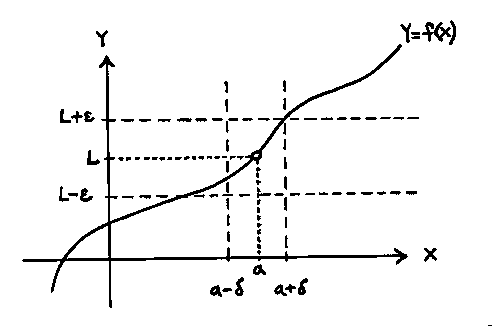
Let's illustrate a limit graphically, using epsilon and delta: 
So when f(x) is within epsilon of the limit, L, then x is within delta of what the limit is approaching, a.
Hence, the limit is true.

Let's look at some examples now:

(easy)

So we wish to show that for all epsilon greater than zero, there exists delta such that if |x-1|<delta, then |f(x)-2|<epsilon.

So let's consider a random epsilon. what would the corresponding delta have to be to make the above implication true?